by Deanna Reder
Debrief of Infographic: Sexual violence in the US prison System
Sexual violence is an ongoing battle in US prisons. “Roughly 200,000 inmates are sexually abused each year in the US’s prison system” (Martynivk, 2014, 4). It is important to address sexual violence in US prison spaces because inmates are already serving long sentences in a “caged” environment (Davis, 2000, 1). Prison rape creates even more traumas for offenders that can affect their psychological, emotional, and physical state of health. With this creative project, I hope to expose the US justice systems’ failure in combating sexual violence in prison. For instance, my infographic shows a statute instilled in 2003 known as the Prison Rape Elimination Act (PREA). US Congress passed the PREA with bipartisan support, but state legislators still fail to implement the law in their state’s prison system (Marcellin & McCoy, 2021, 1). Since 2003, US government officials passed the Reauthorization Reform in 2016, but the cases of prison sexual assault are still rising today (Marcellin & McCoy, 2021, 9). Here, I use my infographic on “Sexual violence in the US prison system” to argue that US policymakers fail to address sexual violence in jails by not developing a current statute condemning forced sexual acts within the prison context.
The 2011 to 2015 statistics from my infographic came from researchers working for the Bureau of Justice Statistics and the US Department of Justice to investigate increasing sexual violence cases in the US’s jailing system. Researchers use the National Inmate Survey (NIS) to conduct their experiment in “233 state and federal prisons. 358 local jails and 15 special correctional facilities” (Beck et al., 2014, 1). The survey questions ask if inmates experience “nonconsensual sexual acts, abusive sexual contacts such as inmate-on-inmate and/or staff on inmate victimization” (Beck. et al., 2014, 1). The study’s sample size is “92,449 inmates being 18 and over, and 1,738 inmates being 16 to 17” (Beck et al., 2014, 1). Researchers analyzed sexual violence through surveys with one group remaining anonymous while answering the questionnaires, as opposed to the participants who place their names on the survey before answering the questions (Beck et al., 2014, 1). In my infographic, the timeline shows that the researchers’ yearly findings from 2011 to 2015 shown an increase in sexual violence allegations between inmate-on-inmate and inmate-on-correctional within US prisons.
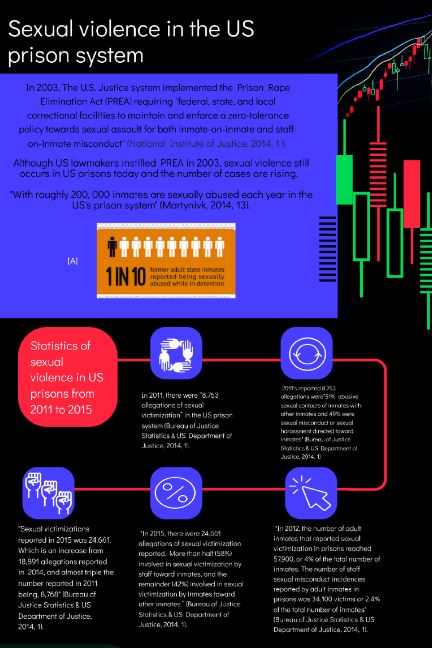
Another prison experiment with results that validates the yearly increase in prison rape cases is Stemple and Meyer’s study funded by the Bureau of justice statistics, depicted in figures 1 and 2 of my infographic. Stemple and Meyer’s 12-month study measured sexual assault in the US Prison system through five different federal surveys: “National Intimate Partner and Sexual Violence Survey (NISVS), National Crime Victimization Survey (NCVS), Uniform Crime Report (UCR), Sexual Victimization in Prisons and Jails Reported by Inmates; National Inmates Survey (NIS 2011-12), Sexual Victimization in Juvenile Facilities Reported by Youth; National Survey for Youth in Custody (NSYC 2012)” (2014,1). From the surveys, researchers found that there is an increase in: the amount of reported prison rape allegations, the number of accusations of correctional staff committing forced sexual acts, and the total cases of other offenders committing sexual violence towards inmates. More specifically, researchers find patterns from the participants’ survey answers. For instance, figure 1 shows experts finding a higher sexual assault rate towards anonymous male inmates. Whereas figure 2 depicts that unnamed inmates experience the most sexual abuse from correctional staff within the prison space. Both figures show that nameless inmates face the highest unreported prison rapes in the US’s prison system.
My infographic possesses US prison rape statistics from 2011 to 2015 because there are no US prison studies showing rates of sexual violence in 2022. There are no current prison experiments showing a high prevalence of sexual assault cases in the US prison space, allowing the issue to slip through the cracks and prohibiting state legislators from addressing the increase in prison rape cases. Today, US lawmakers still fail to address sexual violence in the prison context, with 31 state governors not implementing the PREA and Reauthorization Reform in their state’s prison system, without penalty (Marcellin & McCoy, 2021, 9).
As a community, we must act through resistance by employing our agency to speak up for the rights of inmates. The US prison system already creates hardships for inmates by stripping them of their agencies, like the right to privacy, eat, sleep, and participate in recreational activities; adding sexual violence as a trauma forces an additional burden to inmates’ life. In my infographic, I share that individuals outside the US prison context should demonstrate resistance toward the US’s justice system for not implementing PREA. For example, I think that people should write letters to their state legislators, thus placing pressure on government officials to enforce PREA and Reauthorization Reform. Another resistance tactic that I mentioned in my infographic that helps individuals in society give inmates a voice is protesting. Protests allow people in the community to freely express their views and opinions on many aspects of life. In this case, protests on sexual violence in US jails increase awareness of prison rape in the society, forcing US lawmakers to stop overlooking prison sexual violence as a non-addressable issue.
After completing this creative project, I feel that there needs to be more prison experiments that show prison rape cases increasing each year. Now, US government officials fail to combat the prison rape by leaving inmates defenseless in the US prison context without implementing the PREA and the Reauthorization Reform. Bringing awareness of prison rape into the US community is the only way forward. Through art, survivor narratives, and more current prison experiments, awareness can expose the increasing rates of prison sexual assault, forcing state legislators to implement the PREA and Reauthorization Reform in their state’s prison system. I incorporated three photos in my infographic (pictures A, B, C) created to spread awareness of prison sexual violence. Specifically, photos B and C were designed in honor of sexual assault awareness month, being April, for the community to recognize that prison rape is still an ongoing problem in the US prison system.