by Alice Faymonville
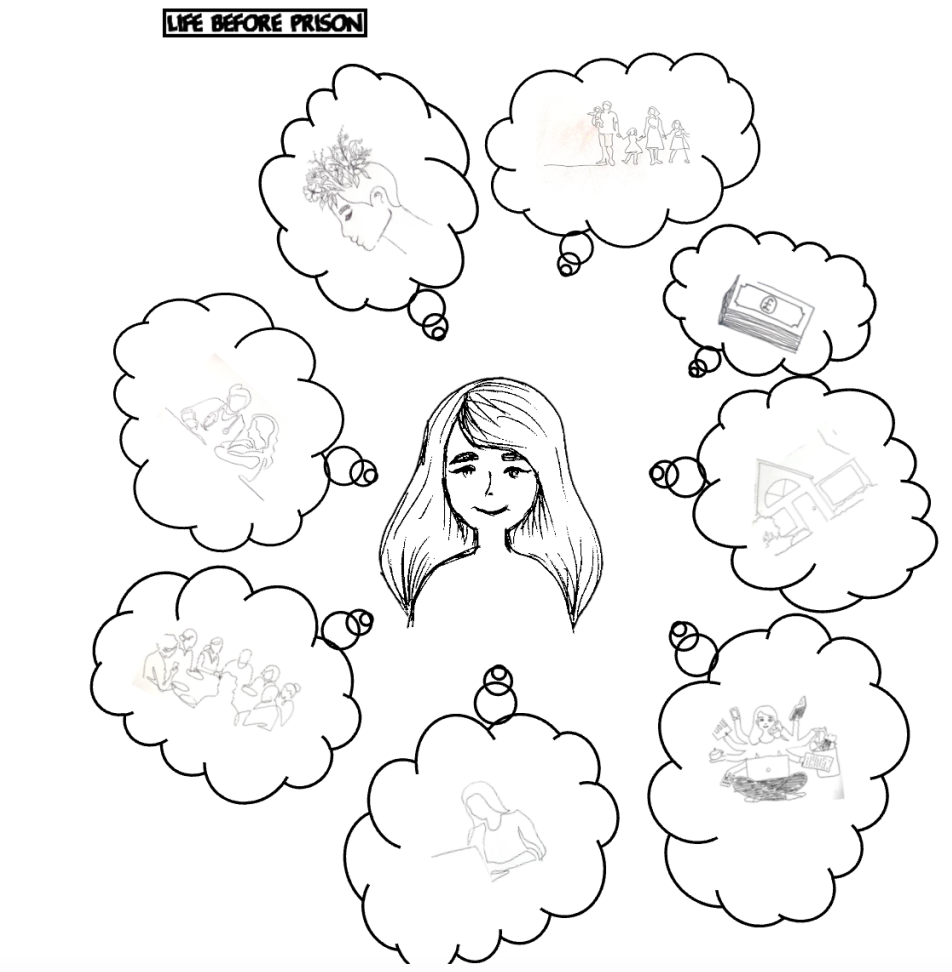
Through these illustrations I seek to demonstrate the hardship prisoners, and more specifically female felons, face once they are released from prison – in fact, contrary to common belief, exiting the walls of prison does not equate with the end of punishment. In a time where the rate of women incarcerated due to non-violent offences is rising, it is essential to draw attention to the damaging aftermath of imprisonment and the deep implications it will have on women’s lives beyond prison. While re-entry into society is an arduous process for former inmates, women face additional hurdles often linked to patriarchal stereotypes put on them by society (SAMHSA, 2020). Drawing attention to this issue is a venture particularly close to my heart. As a feminist woman, I see how once again, women become victims of the patriarchal and capitalist system’s failure to address social inequalities, which women are victims of in the first place. Thus, making women double victims of the system (Olufemi, 2020, p.112). As someone who has never been incarcerated, I do not pretend to know the traumatic experience of serving time in prison. Yet, as an outsider who supports prison abolition, I can call attention to how prisons destroy lives, are catalysts for violence and are reflections of dysfunctional states.
In this juxtaposition of a woman’s life before and after prison, represented through their daily thoughts, I exemplified the difficulties women face when leaving prison. Upon re-entry into society, women struggle with the stigma of serving time in prison even more so than men, due to the patriarchal gender stereotypes portraying women as peaceful and more obedient. This leads to issues such as difficulties in finding employment, as represented by the CV drawing in the illustration, as most employers refuse to employ women who have a criminal record. This is not only highly demotivating but also leads to further difficulties, as without income former prisoners cannot afford housing. This in turn removes the permanent address needed to sign a work contract, to afford health care and to pay the debt they accumulated in prison, as I show in the illustration Life after Prison. It is not rare for former inmates to lose touch with their families while in prison, leading to their further isolation, loneliness and desocialisation – all difficulties ex-felons had to deal with in prison already (Dodge & Pogrebin, 2001; Richie, 2001). Having lost agency within prison, it is an arduous endeavour for former prisoners to re-learn agency over their life in a healthy manner. Without support, be it from family or civil society organisations dedicated to helping former prisoners after release, it is easy for them to fall into 4 addiction and former unhealthy patterns which often lead to recidivism.
A further issue that concerns women more particularly, is reclaiming custody of their children. When mothers are imprisoned, the children often come under the care of social services if the other parent is absent or is unfit to take care of them. In these instances, women often struggle to regain custody as they are stigmatised as violent individuals not embodying the stereotypical motherly figure. This contributes to their loneliness and is a further driver for anxiety, depression and other mental health issues, added to the trauma of imprisonment women face upon exiting prison. Thus, as I have pictured and explained, it seems that the struggles women face after being released from prison are mutually constitutive – one leading to the other, creating a cycle of unhealthy habits which are difficult to escape from. It appears that states do not provide ex-felons with the necessary tools required to start a new life post-prison, embedding them into a perpetual cycle of recidivism (Armstrong & Durnescu, 2016; SAMHSA, 2020).
It is important to keep in mind that these illustrations are stereotypical representations of a woman’s life after prison and cannot be generalised as each and every experience is individualistic. Hence, for instance, while some women might struggle with addiction upon their exit from prison, others might receive support from their families and are less likely to succumb to addiction. Notably, women’s intersecting identities also play a role in how vulnerable they are to the consequences of release from prison and face discrimination on multiple different fronts. For instance, a black woman from a poor socio-economic background, is likely to face more challenges when re-entering society than a wealthy white woman (Olufemi, 2020). Nonetheless, reality remains that the post-prison experience in general creates a vicious circle, which many former inmates fall into, with one struggle often leading to another and finally turning criminogenic. Furthermore, while the difficulties women face after release from prison, represented in the drawings, are the most common ones, they by no means constitute the totality of issues they have to deal with. Added to this, carceral systems differ from country to country and institution to institution. In fact, one cannot compare a prisoner’s life after release from a Norwegian jail, which heavily focuses on rehabilitation, to life after prison in the US, where imprisonment’s main purpose is punishment (Kushner, 2019, p.4).
With these illustrations, I aimed to portray the detrimental effect time in prison has on an individual’s, and more specifically a woman’s, life. Former inmates still pay for their crimes long after release from prison. They are put into a box stigmatising them as violent criminals and are discriminated against on that basis. After serving time in prison, they thus fall into a perpetual cycle of punishment. Prisons end up being criminogenic breeding grounds for further violence. Without the right tools to rebuild a life post-prison, recidivism rates are likely to remain high (Cid, 2009). It is time to finally decriminalise minor offences and create a world where states address the root causes of the inequalities which lead to violence and increased crime rates, rather than using imprisonment as a “catchall solution to social problems” (Gilmore in Kushner, 2019; Olufemi, p.2020). As Olufemi has claimed, “prisons eat people up” (p.111), they “are by their very nature, oppressive” (p.116) and construct former inmates in such a way that re-offending becomes almost inevitable upon release. Thus, humans are used as pawns to further the expansion of the prison-industrial complex – and recidivism feeds it.
Bibliography
Armstrong, R. & Durnescu, I. (2016). Parole and Beyond: International Experiences of Life after Prison. London: Palgrave Studies in Prisons and Penology.
Cid, J. (2009). Is Imprisonment Criminogenic?: A Comparative Study of Recidivism Rates between Prison and Suspended Prison Sanctions. European Journal of Criminology, 6(6), 459-480.
Dodge, M. & Pogrebin, M.R. (2001). Collateral Costs of Imprisonment for Women: Complications of Reintegration. The Prison Journal, 81(1), 42-54.
Kushner, R. (2019). Is Prison Necessary? The New York Times. Retrieved 31 March 2022.
Olufemi, L. (2020). Feminism, interrupted: disrupting power. London: Pluto Press.
Richie, B.E. (2001). Challenges Incarcerated Women Face as They Return to Their Communities: Findings From Life History Interviews. CRIME & DELINQUENCY, 47(3), 368-389.
Substance Abuse and Mental Health Services Administration (SAMHSA) (2020). After Incarceration: A Guide to Helping Women Reenter the Community. Retrieved 8 April 2022, from https://store.samhsa.gov/product/After-Incarceration-A-Guide-To-Helping-Women-Reenter-the-Community/PEP20-05-01-001.