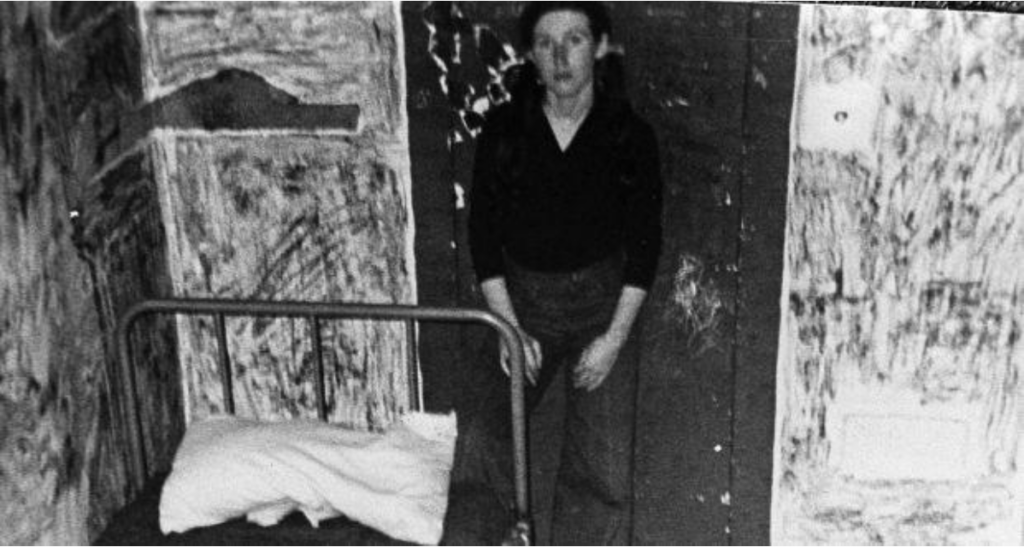
In 1976, male political prisoners in Northern Ireland launched the Dirty Protest, smearing their excrement on cell walls. Female political prisoners at Armagh prison joined their protest, intensifying the provocative nature of this resistance: when denied adequate menstrual products, the women smeared the cell walls in menstrual blood. This caused shockwaves in Irish society, even established feminist groups withheld their support (O’Keefe 2006, p.544-549). The women’s use of menstrual blood was simply beyond the pale: it was too extreme, too dirty, too taboo.
I find this to be a thought-provoking example regarding menstrual blood, within the Irish context and beyond it: why is there such a strong taboo on menstrual blood? Why does it cause shock and disgust? What gives it such potent power? Would spit, or even semen, have deterred support in the same way? The patriarchy would have us treat menstruation as a dirty secret, a little understood and shameful weakness that is best hidden, as if half the planet didn’t bleed every month for most of their life. It is this taboo, and the cultural practices surrounding it, that make acknowledging the banal truth of menstruation – that it is common and occurs in day-to-day life – a symbolic act of resistance.
While I have frequently come across research on gendered violence, rarely have I read about menstruation. The unease that attends the mention of something perceived as exceedingly private and shameful has been instrumentalised to relegate women to the private realm, to confine them and limit their agency. The Irish case exemplifies this in the form of strip searches and raids on resistance fighters’ homes where sanitary items were pulled out and displayed to humiliate (O’Keefe 2006, p.540). The women of the Northern Irish resistance were able to overcome the shame that patriarchy worked so hard to instil in them, allowing them to use their menstrual blood as a weapon against the oppressor. In doing so, they defied patriarchal disciplinary practices of biopower in Foucault’s sense (the methods employed by the state to control and regulate its people and their biological lives (Wilcox 2015, p.24).
To borrow from Kristeva’s theory of abjection, the shock and horror caused by menstrual blood is beyond logic or a realistic threat to one’s life – rather its “what disturbs identity, system, order” (Kristeva 1941, p.4). The taboo on menstrual blood makes no rational claim that it is harmful – nonetheless, we are not supposed to acknowledge, see or discuss it. By bringing it to light, making it visible and tangible, we disrupt and destabilise the established order – this, I believe, is what makes it so powerful and scary. We make public what has been relegated to the private realm by the heterosexist nation state. The women weren’t just brandishing their menstrual blood, they were demonstrating a disregard for the rules that oppressed them. It is symbolic, precisely because they showed what they should not, thereby weaponising the taboo. By flaunting it, they reclaimed the power the patriarchy wielded in its shame-inducing qualities. I find this inspiring: it means power is neither stable nor intrinsic. Power can be taken from the oppressor and repurposed.
Bibliography
- Kristeva, J 1941, Powers of Horror: An Essay on Abjection, Columbia University Press, New York
- O’Keefe, T 2006, ‘Menstrual Blood as a Weapon of Resistance,’ International Feminist Journal of Politics, vol. 8, no.4, pp. 535-556, DOI: 10.1080/14616740600945123
- Pacemaker, C 1980, Mairéad Farrell – a ‘Dirty Protester’ from Armagh Prison, accessed from ‘Second-class republicans? Sinn Féin, feminism and the women’s hunger strike‘
- Wilcox, L.B 2015, Bodies of Violence: Theorizing Embodied Subjects in International Relations, Oxford Online Scholarship, DOI: 10.1093/acprof:oso/9780199384488.001.0001